Archive for the ‘Technical Library’ Category

3-D Fast Cut

Monday, May 13th, 2013

3-D Fast Cut Ball Head Set-UpThis month in Tech Notes, we’re going to deviate a little bit from our usual how-to. Instead, we’re going to explain in more detail how you can use the 3-D Fast Cut™ to perform a wide range of machine operations.

Before we get into the ins and outs of the 3-D Fast Cut™ System, let’s look at a little history. Grinding is one of the earliest methods for machining valve seats along with the Neway Valve Seat Cutter. These methods all machined a single angle at a time which could be time consuming.  Multi-angle seat cutting first appeared in the Goodson catalog in 1991 Goodson Cover1991 when cutter bits and tooling from mira® were added to the product line. The first multi-angle cutter blades (FT-blades) appeared in the 1994 Goodson catalog and the 3-D Fast Cut™ system was born in 1997. The rest, as they say, is history.

One of the advantages of the multi-angle cutting systems (like the 3-D Fast Cut) is that you can cut more than one angle at a time. Blades are made from tungsten carbide for their cutting performance and long life. Blades can also be customized; if you need a specific profile, it’s not a problem. Blades can be sharpened and if they get chipped or can’t be sharpened any longer it won’t cost you and arm and leg to replace them.

Multi-Angle Cutter Blade from GoodsonAnother advantage is that the tooling and blades are pretty much interchangeable from one system to the next. This means that the 3-D Fast Cut™ tooling you can buy from Goodson is fully compatible with any you may have from Kwik Way or Peterson or Rottler or Serdi or ….

The biggest disadvantage to the whole multi-angle cutting system, regardless of who makes it, is initial investment. Once you get started, though, you can add blades or holders as you need them and soon, you’ll have an impressive range of tooling.

Examples of the range of ball heads available from GoodsonOver the years since the 3-D Fast Cut™ first appeared in the Goodson catalog, there have been a lot of updates and improvements to the tooling. You can now find Ball Heads that are smaller, larger or wider than the standard body. With all of these modifications, it’s now possible to cut seats that range from .550” up to 3.150”. All with the same basic seat cutting system.

Comparison of blade sizes - micro on left, standard on rightOne of the newest modifications to the 3-D Fast Cut™ system is the Micro tooling that enables seat cutting in very small bores. To accommodate these “micro” seats, the standard tip holders and the tips have been modified to fit (see picture at left showing relative blade sizes) without sacrificing cutter integrity or interfering with the combustion chamber wall. We didn’t forget the valve guides in the equation either. The 3-D Micro Tooling fits .236” top pilots that are available from .156” to .277”.

Just as we’ve added tooling over the years, we’ve added cutter blade profiles. In the 1994 catalog we showed a whopping 23 cutter profiles. Today (at least as of this writing) we stock 120 different profiles for everything from lawnmowers to land movers. As we said before, custom profiles are available (see back for more information).

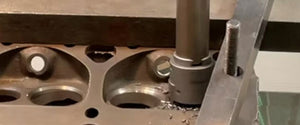
The tech department (the guys who handle the majority of our new product research and development) did some creative thinking and came up with some other uses for the 3-D Fast Cut™ tooling. They like to say, “It’s not just for seats anymore.” With the addition of some custom holders, it’s possible to cut spring pads, contour bowls and drive counterbore cutters on your guide and seat machine.

One of the most interesting variations of the 3-D Fast Cut tooling was introduced in 2006 as a means of removing valve seat inserts.

As you can see, the 3-D Fast Cut™ system is a versatile and useful system to have in the shop. If you have an idea for how to expand the program even more, give us a call at 1-800-533-8010.

For more information about 3-D Fast Cut™ or any other technical topic, contact the Goodson Techxperts™ at 1-800-533-8010 or visit the Technical Library on our website.

Tips for Choosing the Right Brake Lathe Tip

Tuesday, February 12th, 2013

It’s not as easy as it sounds. Choosing the right brake lathe cutting tip, that is. There are a few questions you need to ask yourself before you decide on the tip you need.

What grade of tip do I need?

Goodson carries three grades of tips

  • Standard Carbide
  • Honed Edge Carbide
  • Premium Titanium Coated Carbide

The common element here is that all of the cutting tips are carbide. Why carbide? Carbide is used because it holds the cutting edge longer and it will stand up to the wear and tear of daily use. In fact, carbide can hold the cutting edge up to 20 times longer than ordinary tool steel.

Let’s look at each of the grades and see why there are three grades to choose from.

Standard Carbide tips are your basic all-purpose cutting tips. They are parallel ground carbide and are ideal for resurfacing cast iron drums and rotors.

Honed Edge Carbide tips are a step up from the Standard tips. They are both parallel and peripheral ground to give the tips a sharper cutting edge. Honed Edge tips can be used for cast iron and composite rotors and are ideal if there is any rust on the rotor surface. The honed edge will cut through the rust without losing their edge.

Just because these tips can stand up to rust doesn’t mean you can try to turn a rotor that has heavy surface rust. You should still remove as much of the surface rust as you can before you start cutting on the lathe.

Premium Titanium (TiN) Coated Carbide tips are the cream of the crop, the top of the heap. These tips are also parallel and peripheral ground to create a super sharp cutting edge. They are then coated in titanium to help retain the edge and prevent corrosion. Use titanium coated carbide tips when turning cast iron and composite rotors but DO NOT use titanium tips on rusted surfaces.

20 Cutting EdgesW13 Cutting Edgesha10 Cutting Edgest shape tip do I need?

Most brake lathe cutting tips are triangular. That has been the standard for many years. Some brake lathes use a parallelogram shape (remember high school geometry?) but that is the exception. A newer shape for brake lathe cutting tips is round. Round tips have been used for years in metalworking and they’ve moved over to automotive work more recently.

Round tips have a few advantages over other shapes, including a smoother cut and more cutting surfaces depending on the cut depth as you can see in the illustrations above right.

Negative rake brake lathe tipWhat rake should I get?

Brake Lathe Cutting Tips are either positive or negative rake. Whether you need positive or negative rake is determined by your brake lathe design. You can’t use a negative rake tip on a machine designed for positive rake tips without making modifications to the lathe. You may get away with this switch by choosing a different tip holder, but we recommend staying with the rake tip that the manufacturer specifies.

Positive rake brake lathe tipDue to their design, positive rake tips have 3 cutting edges and negative rake tips have 6 cutting edges. For more on rake, see the illustrations at right.

So, which tip do I order?

We’ve covered a lot of ground here, but you may still be asking which tip you should order for your shop. The best way to determine which tip you want is to look at what tip your lathe manufacturer specified. The Goodson catalog and website list most OE tips numbers that correspond to our order numbers so it should be fairly easy to pick out the right tip.

Measuring Brake Lathe Tips

Measuring Brake Lathe Tips

If you don’t have the OE number and aren’t sure which brake lathe model you have (maybe you bought it second hand), you can still figure out which tip you need simply by measuring the height (A), the thickness (B) and the hole (C) size (if there is a hole). You’ll find a chart with all of the tip measurements in the 2013 catalog on page 110 or go to the Brake Tip Measurement Chart on the website. It’s no problem if you don’t have access to either of these charts; just call Goodson at 1-800-533-8010 and give the dimensions to your customer service representative. They’ll be able to convert the sizes to the tip you need in no time.

As always, if you have any questions about choosing a brake lathe cutting tip, contact the Goodson Techxperts™ or visit the technical library on the Goodson website.

Caring For Your Precision Measuring Tools

Tuesday, January 15th, 2013

As a machinist you rely on your measuring tools to be accurate. Proper care is necessary to ensure accuracy on a consistent basis. Here are some tips for taking care of your precision measuring tools.

Vernier Caliper from GoodsonVernier Calipers

  • When not in use, be sure to return the caliper to its storage case
  • Never drop or throw your caliper
  • Don’t lay the caliper on the bench where it can get banged around and damaged
  • Don’t lay the caliper in any kind of debris (metal chips or grinding grit)
  • Be sure to check the caliper’s calibration periodically and follow the manufacturer’s instruction for recalibrating if necessary
  • Only use your caliper on stationary parts
  • Protect your dial calipers from dust which can get inside the dial and cause inaccurate readings
  • Do not exceed the measurement range of the caliper

Micrometer from GoodsonMicrometers

  • Micrometers are NOT clamps
  • Never spin the micrometer while holding the thimble
  • Never drop or throw your micrometer onto the bench
  • Don’t lay the micrometer on the bench where it can get banged or damaged
  • Avoid laying the micrometer in metal chips, grinding grit or any other type of debris
  • Always store your micrometers in their protective cases
  • Be sure to use the correct micrometer for your application (for example, if you’re measuring a piston with a diameter of 4.5”, use a micrometer with a measurement range of 4.0-5.0 inches)
  • Check the micrometer’s calibration on a regular basis and recalibrate according to the manufacturer’s instructions
  • Never use a micrometer on parts in motion
  • Remember that your micrometers will be affected by the heat of your hands and your surroundings so they should be used at room temperature and handled as little as possible

Goodson Dial IndicatorDial Indicators & Dial Bore Gauges

  • Never drop or throw your dial indicators or dial bore gauges onto the bench
  • Return your dial indicators and dial bore gauges to their cases when you are finished with them
  • Do not lay your dial indicators or dial bore gauges on the bench where they can get damaged
  • Always use your dial indicators and dial bore gauges at room temperature to avoid distortion from heat or cold
  • Check the accuracy of your dial indicators and dial bore gauges periodically and recalibrate as needed
  • Never use your dial bore gauge on moving parts

Precision Level from GoodsonLevels

  • Always keep the vial cover closed when you are not using the level
  • You must check the level of your level periodically (for complete instructions visit the Tech Library at Goodson.com)
  • Do not drop or throw your level onto the bench
  • When not using your level, be sure to store it where it will not be banged into or have anything drop on it
  • Always use your level at room temperature to avoid distortion of the leveling bubble caused by heat and cold

A final tip

This tidbit comes from Jim Tapp, Goodson Tech Services. “Put a clean, dry shop towel on the bench and put the measuring tool there while you’re working with it. The shop towel will cushion the measuring tool and keep it clean. It’s also a good signal to your co-workers that they shouldn’t lay something down there.”

We’ve barely scratched the surface with these care and use tips for precision measuring tools. For more information, visit us online or call Tech Services at 1-800-533-8010.

Plateau Honing 101 – The role of Flex-Hones and Ultra Finish Hones

Thursday, August 23rd, 2012

Jim Tapp, Tech Services DepartmentBy Jim Tapp,
Goodson Tech Services Manager

We get a lot of questions here in the Tech Department about Flex-Hones and Ultra Finish Hones. What’s the difference? Can I use Ultra Finish Hones to deglaze a cylinder? Are they interchangeable?

Good questions all around. And that’s what we’re going to talk about this month. But before we do I need to go through a little history.

Back in the old days (maybe 20 years or more) cylinder honing was done almost exclusively with rigid hones and honing stones which led to some problems such as rough cylinder surfaces. It used to be that the rings scrubbed or shaved off the peaks of rough material left by the rigid stones over time. You may have heard of breaking-in a cylinder. That’s what this is.

This process works but it has a couple of down sides. First, the rings and cylinders wear much faster and second, all the debris being shaved off of the cylinder surface ends up in your oil which can cause engine component wear.

Understanding the evolution of piston rings is important too. Early thought was wide rings with high tension. The wide rings were tough enough to handle the rough surfaces (to a point) but they also resulted in higher emissions. So as emission requirements evolved, piston rings did too. Today’s rings are narrower with low tension so they result in lower emissions and longer ring life. But they come from the factory pre-lapped so they can’t take the abrading that the older style rings could handle. So as the rings evolved, the honing processes had to as well.

The evolution of the rings gave birth to a finish that’s called a plateau finish. As the name implies, instead of the peaks and valleys created by the hard abrasive, a plateau is created by knocking down the peaks on the cylinder walls. This is where Flex-Hones® and Ultra Finish Hones come into the picture.

Achieving a plateaued cylinder bore is a multi-step process:

Hone to size with coarse grit stones – between 150 and 220 grit – using a portable hone or a honing cabinet with rigid stones and wipers.

Remove the peaks using a fine (280 or finer) grit flex-hone depending on the ring face material.

Remove the material that has become embedded in the crosshatch with an Ultra Finish Hone.

Keep in mind that this isn’t written in stone (no pun intended). You don’t have to do all of the steps above, but you’ll get a better cylinder surface if you do. You’ll notice that these steps are a bit vague. I haven’t given you any guidelines for how much to remove with each pass of the hone and that’s deliberate. That’s up to you. You’ve developed your own technique based on experience, just like I have so listen to yourself.

Let’s take a closer look at Flex-Hones and Ultra Finish Hones to give you more understanding of their roles in creating a plateau finish.

Flex-Hones®

Flex-HoneFlex-Hones®. Ball-Hones. Dingleberry Hones. These are three of the most common names for this honing alternative.

By definition, the flex-hone® is a resilient, flexible, honing tool with a soft cutting action. Flex-Hones are made with a heavy-duty twisted wire shaft that holds flexible nylon strands coated with abrasive globules. These globules conform to the shape of the surface and “float” over the surface you’re honing to create a consistent crosshatch finish to enable better oil retention in the cylinder bore. Remember, because the flex-hone follows the shape of the cylinder, you should never use it to do the initial honing. All this will do is perpetuate any flaws that already exist in the bore and that’s what you’re trying to eliminate by honing.

Flex-Hones are available in several abrasives – silicon carbide, aluminum oxide, boron carbide, tungsten carbide, and alumina zirconia with grits from 20 to 800. There is a wide range of sizes from 4mm in diameter all the way up to 24-1/2 inches covering an extensive list of applications.

Here’s where two of the biggest differences between Flex-Hones and Ultra Finish Hones can be found. Flex-Hones allow you to deglaze a bore and will remove material from the bore, though not as much as a rigid honing stone.

Take a look at the illustration at left. You’ll see an overly simplified rendering of what a bored cylinder looks like after the first honing step. There are sharp peaks that will abrade the rings if you install the pistons and rings now. Back in the day, this was the breaking-in step. But as we’ve already discussed, those days are gone. The newer rings can’t take the abrasion so you’ll need to round over these sharp peaks and that’s where the flex-hones come in.

The image at left illustrates the result of a pass with a flex-hone. You’ll note that the peaks are rounded over and the valleys have been filled slightly with debris from the flex-hone pass. In correcting one problem we’ve kind of created another. It used to be that we’d recommend you clean the cylinder at this point with soapy water and a nylon brush to remove the last of the debris from the crosshatch. It helped.

But a few years back an enterprising person had the idea of adding an abrasive right to the nylon in the brush. It yields and penetrates the crosshatch depth to eliminate debris. So was born the Ultra Finish Hone.

Ultra Finish Hones

The ultra finish hone is made up of a mono-filament nylon strand that is impregnated with fine abrasive material that breaks down as the strands brush across the bore surface.

According to one manufacturer, “These tools are specifically designed for mechanical finishing tasks such as: deburring, sharp edge removal, radiusing, edge contouring, de-fuzzing, surface refinement and conditioning, plateau finishing, blending imperfections, reduction of surface stresses and micro crack propagation, cleaning, polishing and surface wiping prior to inspection gauging.” Whew, what a mouthful. Ultra Finish hones, aka plateau hones, soft hones, whisker hones or brush hones, will NOT enlarge or deglaze the bore under normal use, unlike Flex-Hones. They are basically deburring tools that remove the folded materials partially filling the crosshatch depth – or as I call them, “the uglies.”

Back to the illustrations. Fig. 3 shows the results of the Ultra Finish Hone. You’ll see that the debris that was left has now been removed, leaving a plateaued cylinder that’s already broken in.

So we’ve seen that Flex-Hones and Ultra Finish hones perform similar, but not identical, procedures. They are NOT interchangeable in engine cylinder applications. And there’s one other difference. Ultra Finish Hones are available in 120 and 320 grit in either silicon carbide or aluminum oxide abrasives.

There are a couple of cautions when using Ultra Finish hones. Too much plateau honing will make the cylinder too smooth and you won’t have adequate oil retention. And on the flip side, too little will leave the surface too rough and will cause ring and cylinder wear. I recommend somewhere between 12 and 20 strokes per cylinder to achieve a properly deburring. Again, I’m leaving the exact application up to you and your feel for what you’re doing.

This gives you a quick tour of Flex-Hones and Ultra Finish Hones, their differences and their similarities. To find out more about Flex-Hones, visit the Brush Research website and for more on Ultra Finish hones, check out Osborn International‘s site. You can also Google plateau hone, flex-hone and ultra finish hone for additional Internet articles and sites.

Flex-Hones 101

Thursday, August 23rd, 2012

We get a lot of questions about Flex-Hones® and Ultra-Finish Plateau Hones so in this week’s Tech Tip I’ll give a quick explanation on the differences between them.

Flex-HoneThe most common Flex-Hone® is made of silicon-carbide. This is a silicon-carbide ball, affixed to a flexible nylon filament, connected to a drive shaft, driven by a portable drill. They are used to hone cast iron cylinders. Silicon-carbide is a strong, blocky abrasive that wears well and removes material quickly.

The aluminum-oxide hone is constructed just as the silicon-carbide is. The difference is that the aluminum-oxide material is most effective in steel and Nicasil cylinders. The material is a softer grain, allowing it to break down, exposing new sharp abrasive grains making it aggressive enough to remove and prepare the finish on hard material cylinders.
Diamond flex hones, being the most expensive, are our last abrasive material. These are usually used in small diameters because of the cost. The diamond abrasive removes material most effectively in non-ferrous materials such as valve guides manufactured of bronze, copper, and other alloys.

OK, now for soft hones, whisker hones, plateau hones, and ultra finish hones. Despite all of the names, they are the same thing and they are not hones in the true sense. Instead, they are a cleanup tool for materials severed in the honing process. Abrasive material is mixed into the mono filament bristles of this tool. Shaped as the other abrasive hones, this hone has no abrasive balls attached. Remember the abrasive is in the bristles in a very small amount. This hone will not deglaze, it is designed to deburr or remove severed or partially severed material hanging in the bore hidden in the hone marks.

For a more extensive explanation of the differences and uses of Flex-Hones® and Ultra-Finish Plateau Hones, check out this article in our Technical Library.

NEXT WEEK: Honing lubricants used with these hones

Cleaning Media 101 – Part 3 of 3

Thursday, July 26th, 2012

Over the past two weeks, we’ve covered Glass Bead and Airless Blaster Parts Cleaning. Today, we’re wrapping up our series on cleaning media with Parts Tumbler Media.

Parts Tumblers

The parts tumbler does a good job of cleaning smaller components. Some advantages of parts tumbling are:

  • Low maintenance
  • Time to clean is short
  • Can be used on a wide variety of shapes and material with the correct media.

As with glass beading and the airless blaster, care must be used to avoid damaging machined surfaces.

Parts Tumbling in the Auto Machine Shop

Parts Tumbler Media - Steel DiagonalsThe most common usage of the tumbler in the auto shop is in cleaning valve train parts and smaller engine fasteners.  When cleaning these parts, such as valves, you need media that has weight to it.  Since you’re looking to abrade larger quantities of baked on carbon you would use Steel Diagonals. (Order No. PTM-20D).  As the valves are tumbled, they are bombarded by the heavier media, removing the deposits. In this instance valve stem protection (VSP-16) must be used to prevent damage to polished stems.

Irregularly shaped parts such as valve springs, retainers, etc. clean well with Parts Tumbler Media - Steel BallconesSteel Ballcones (PTM-20BC) These are a lighter weight and clean without damaging valve springs and retainers.

Parts Tumbler Media - Ceramic DIagonalsCeramic Diagonals (PTM-20CR) are our lightest media and used on soft materials such as brass and aluminum.  Ceramic Diagonals work well with alternator and distributor housings.

We recommend you use Parts Tumbler Solution (PT-SOL) with all of these media.  This solution softens deposits for easier removal and combines with removed deposits to carrying them to the sump area of the tumbler, releasing them there.

Together with the first two parts of this series, we’ve talked briefly about various methods for parts cleaning. As you can imagine, we’ve barely scratched the surface, but this should give you enough information to get started. Don’t forget, we have a full Technical Library that includes more information about parts cleaning. As always, if you have any questions about Parts Tumbler Media or which media to use for which part, contact the Goodson Tech Services Department at 1-800-533-8010 or shoot us an email.

Cleaning Media 101 – Part 2 of 3

Thursday, July 19th, 2012

We started a series on Cleaning Media in last week’s Tech Tip of the Week on Glass Beading We continue today with a look at Airless Blasters, their uses and which media to use for which process. Next week we’ll wrap up this 3-part series with a look at Parts Tumblers.

Airless Blasters

Parts cleaning with an Airless Blaster is less labor intensive than glass beading and is generally used following thermal cleaning. In other words, once you’ve “cooked” the parts in a thermal oven, you use blast media to remove the carbonized materials left over.

Select the correct media for the job

Steel Shot for Airless BlastersGoodson stocks three cleaning media or shot for different applications. The first is Steel Shot, used primarily for removing materials from cast iron or steel. Used in a conservative manner, is effective in removing baked carbon and rust. But remember, leaving parts in a blaster too long will compromise machined surfaces, including deck and bearing mounting bores. One big drawback to steel shot is that it will rust and leave a dark red finish on parts.

Stainless steel shot is also available, in conditioned and cut wire. This material is used primarily for aluminum parts. The stainless shot won’t rust like steel shot so it doesn’t leave the reddish finish on cleaned parts. It removes soil and oxidation and produces a like-new aluminum appearance.

Conditioned Stainless Steel Shot for Airless BlastersConditioned Stainless is simply shot that has been blasted into a hardened steel plate, leaving a spherical or ball shaped abrasive. Again short blast times are recommended to minimize distortion and surface damage to machined areas. Dry parts are an absolute necessity to maximize cleaning while minimizing labor time.

Stainless Steel Cut Wire Shot for Airless BlastersCut Wire Stainless is used to clean the worst oxidized aluminum materials. This media is very aggressive and used exclusively before a complete reman or repair including TIG welding (tungsten inert gas). All machined surfaces will require re-machining.

Just as with glass bead cleaning, these media require a complete soap and water scrub down before continuing the build. The cleaning abrasives can be trapped in oil galleys, water jackets, and bolt holes. Be very careful!

Check back next week for the final part of this series as we discuss Parts Tumbling and Tumbler Media.

Cleaning Media 101 – Part 1 of 3

Wednesday, July 11th, 2012

The Whys and Why Nots of Cleaning with Glass Beads

Today we’re starting a short series on the various cleaning media available to the engine builder. We’ll be giving you tips and tricks for using each media type, including glass beads, tumbler media and airless blaster media. Check out the Goodson Tech Tip of the Week for the rest of the series.

Goodson Glass Beads - GB-CMOne of the most widely used cleaning media is the glass bead. Glass beads are primarily used to blast engine components free of carbon base soils and oxidation. Blasting is done in a cabinet to contain and recycle the media being used.

The cleaning process is done with beads being siphoned from a storage area, through a hand held gun that accelerates the media with air pressure.  The removed material and broken beads are passed through an exhaust system into a filter, that can be cleaned manually.

Glass Beading Set upTips for faster glass beading

Keep your air pressure at 60PSI or below.
If you set operating air pressure in excess of 60 to 65 P.S.I., glass beads will shatter upon contact with the part being blasted.  A shattered bead will be removed to the filter, just like the materials that have been removed from your blasted component.  This is the largest WASTE of beads, and beads equal money.

Ensure that all parts to be glass bead blasted are as dry as possible.
Blasting a part that is wet with oil or water will take more time than blasting a dry part.  Always  remove as much wet soil and grime as possible BEFORE starting the glass beader.  Bead blasting parts is labor intensive enough, why prolong the time involved?

Remove all glass beading residue before proceeding.
Remember  to clean parts after glass beading, using warm soapy water, followed by a clear water rinse.  Parts solvent does not cut it.  If bolt holes, water jackets, and oil galleys are involved, they too must be cleaned carefully. Be sure any orifices are clear of glass beads; you wouldn’t want a tiny glass bead compromising your engine build, now would you?

We could probably write pages and pages about the advantages and disadvantages of different styles of glass bead guns, gloves, etc., but we’ll leave that for another post.

Check back next week for another in our series on Cleaning Media.

Taking Care of the Most Important Thing in Your Shop – YOU

Friday, June 29th, 2012

By Janet Tapp, Goodson Advertising Manager

We’re taking a little side trip with this week’s Tech Tip of the Week. Here in Minnesota where Goodson is headquartered, it’s hot. Yes, Minnesota, land of the Ten Thousand Lakes and just as many snowbanks is HOT. How hot?  Yesterday, June 27th we hit 96 degrees on my car’s thermometer. And like we say around here, it’s not the heat, it’s the humidity. I think we had about 96% humidity yesterday too.

This heat wave we’re having got me to thinking about all of the guys working in the heat. I know that a lot of shops don’t have air conditioning and I have yet to see an air conditioned race track so we decided its time to do a tech tip about dealing with the heat. There is a lot of summer left and with heat like we’ve been having already, it’s important for you to take care of the most important thing in your shop – YOU.

Be sure that you’re staying hydrated

When it’s hot and humid, you need to take in more liquids than you normally do. Don’t wait until you’re thirsty. By that time it’s too late. When you get dehydrated, you make mistakes. Your judgement gets clouded and you could hurt yourself or someone else if you’re working on a machine. Take my word for it, you do NOT want to end up in the emergency room because of dehydration. Not only will it cost you a bunch of money, but if you’re anything like the machinist in my family, you’ll feel pretty foolish too. You could have avoided the whole experience just by taking a few minutes every now and then to get a glass of water. If it is extremely hot or you’re working hard, drink fruit juice or sports beverages to help replace the sodium and minerals that you’re sweating out.

Don’t get overheated

There are several heat related conditions that you need to be aware of and take steps to avoid. They range from heat rash, an annoyance all the way to heat stroke or death. I could probably write many paragraphs about each of these conditions, but I’ll just give you a quick recap of the symptoms you need to be on the lookout for:

  • heavy sweating (heavier than normal) or absence of sweating with red hot, flushed dry skin
  • paleness
  • muscle cramps and/or pain
  • fatigue (unnatural tiredness)
  • weakness
  • dizziness and/or light-headedness
  • headache
  • nausea
  • fast and shallow breathing
  • fainting
  • vomiting
  • rapid pulse
  • hallucinations
  • confusion
  • agitation
  • disorientation
  • seizure
  • coma

So, did I scare you enough for you to take this seriously? I hope so. If you’d like to read more about heat related conditions, check out some articles on MedicineNet. Not only do they give more details about the conditions and their symptoms, there are tips on how to prevent heat related illnesses.

Pace Yourself and Use Common Sense

Whether you’re at your shop, at the track or anywhere else that leaves you exposed to the heat, use common sense and pace yourself. You may think that you just have to get this last job done and you can push yourself through it, but you don’t. You’re no good to yourself or anyone else if you’re laid up because you’ve gotten overheated. I know you’re out there working hard and building an appetite, but be careful not to eat heavy, protein-rich meals. These just raise your body temperature.

Heat waves, fortunately, don’t last forever (at least not here in Minnesota), but they can really put a hurt on you and your business if you’re not careful. Take care of yourself wherever you’re working – the shop, the track or wherever, we want to keep you around for a while. And don’t forget your pets. They suffer in the heat just as much as you do and they’re depending on you to take care of them.

The Good, The Bad, And it Gets Ugly

Thursday, June 14th, 2012

Jim Tapp, Tech Services Department
By Jim Tapp

Goodson Tech Service

Is the grinding or cutting of valve seats taking way more time than necessary? Does it seem that hardly any of the seats are finishing on the same plane? Can’t seem to get a handle on what happened?

Is it bad leveling?
A defective cutter?
A non-concentric pilot?

Wow, we have all kinds of possibilities! And after we have eliminated one cause after another, we give up. Hey the seat’s good enough!

Not knowing the real problem, it becomes a living nightmare, head after head after head.

Ask yourself again, what have you forgotten? What else could be causing this problem? It’s easy to overlook the obvious – Replacement thick wall valve guides.

It would be wonderful deal if all replacement false guides were manufactured consistently and concentrically, but they are NOT. It has been my experience that it’s about a 50-50 dice role. Getting cast replacement guides to check out at a T.I.R. less than .001”, as they are guaranteed to be, doesn’t happen. Please don’t get me wrong, there are many guides manufactured perfectly, but they are usually a little more costly. Like always, you get what you pay for, hopefully.

How the heck do I check valve guides quickly and accurately?

Goodson Valve Guide Run-Out GaugeWith the Goodson Valve Guide Run-Out Gauge, of course. It takes a little over a minute to check a set of 16 valve guides for concentricity on both ends, after a short set up time. The part numbers for the tool are: VRG-375, VRG-385, and VRG-437, dependent on your pilot top size. This allows you to be in control of your valve seat work.

Need a little more information about this or any other Goodson tool? Call the Goodson Techxperts at 1-800-533-8010 or shoot us an email.