Archive for the ‘General Engine Building’ Category

3-D Fast Cut

Monday, May 13th, 2013

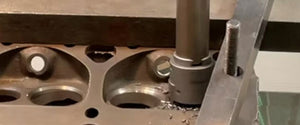
3-D Fast Cut Ball Head Set-UpThis month in Tech Notes, we’re going to deviate a little bit from our usual how-to. Instead, we’re going to explain in more detail how you can use the 3-D Fast Cut™ to perform a wide range of machine operations.

Before we get into the ins and outs of the 3-D Fast Cut™ System, let’s look at a little history. Grinding is one of the earliest methods for machining valve seats along with the Neway Valve Seat Cutter. These methods all machined a single angle at a time which could be time consuming.  Multi-angle seat cutting first appeared in the Goodson catalog in 1991 Goodson Cover1991 when cutter bits and tooling from mira® were added to the product line. The first multi-angle cutter blades (FT-blades) appeared in the 1994 Goodson catalog and the 3-D Fast Cut™ system was born in 1997. The rest, as they say, is history.

One of the advantages of the multi-angle cutting systems (like the 3-D Fast Cut) is that you can cut more than one angle at a time. Blades are made from tungsten carbide for their cutting performance and long life. Blades can also be customized; if you need a specific profile, it’s not a problem. Blades can be sharpened and if they get chipped or can’t be sharpened any longer it won’t cost you and arm and leg to replace them.

Multi-Angle Cutter Blade from GoodsonAnother advantage is that the tooling and blades are pretty much interchangeable from one system to the next. This means that the 3-D Fast Cut™ tooling you can buy from Goodson is fully compatible with any you may have from Kwik Way or Peterson or Rottler or Serdi or ….

The biggest disadvantage to the whole multi-angle cutting system, regardless of who makes it, is initial investment. Once you get started, though, you can add blades or holders as you need them and soon, you’ll have an impressive range of tooling.

Examples of the range of ball heads available from GoodsonOver the years since the 3-D Fast Cut™ first appeared in the Goodson catalog, there have been a lot of updates and improvements to the tooling. You can now find Ball Heads that are smaller, larger or wider than the standard body. With all of these modifications, it’s now possible to cut seats that range from .550” up to 3.150”. All with the same basic seat cutting system.

Comparison of blade sizes - micro on left, standard on rightOne of the newest modifications to the 3-D Fast Cut™ system is the Micro tooling that enables seat cutting in very small bores. To accommodate these “micro” seats, the standard tip holders and the tips have been modified to fit (see picture at left showing relative blade sizes) without sacrificing cutter integrity or interfering with the combustion chamber wall. We didn’t forget the valve guides in the equation either. The 3-D Micro Tooling fits .236” top pilots that are available from .156” to .277”.

Just as we’ve added tooling over the years, we’ve added cutter blade profiles. In the 1994 catalog we showed a whopping 23 cutter profiles. Today (at least as of this writing) we stock 120 different profiles for everything from lawnmowers to land movers. As we said before, custom profiles are available (see back for more information).

The tech department (the guys who handle the majority of our new product research and development) did some creative thinking and came up with some other uses for the 3-D Fast Cut™ tooling. They like to say, “It’s not just for seats anymore.” With the addition of some custom holders, it’s possible to cut spring pads, contour bowls and drive counterbore cutters on your guide and seat machine.

One of the most interesting variations of the 3-D Fast Cut tooling was introduced in 2006 as a means of removing valve seat inserts.

As you can see, the 3-D Fast Cut™ system is a versatile and useful system to have in the shop. If you have an idea for how to expand the program even more, give us a call at 1-800-533-8010.

For more information about 3-D Fast Cut™ or any other technical topic, contact the Goodson Techxperts™ at 1-800-533-8010 or visit the Technical Library on our website.

WILK’S ATLANTA GOAL: KEEP UP THE PRESSURE

Wednesday, May 1st, 2013

COMMERCE, Ga. (April 30, 2013) — Tim Wilkerson and his Levi, Ray & Shoup Shelby Mustang Funny Car team didn’t win the race this past weekend in Houston. They didn’t win the race the weekend prior to that, in Charlotte. But, beyond any doubt, they’ve blossomed over the past two events, clearly performing well under a variety of conditions, and it would not be a stretch to say they’re running with the big dogs. A semifinal finish at the 4-Wide race, followed by a runner-up finish at the SpringNationals, will earn you that designation, especially when the results were claimed in solid consistent fashion.

Looking for trends? Wilk entered the Charlotte event in 12th place on the Mello Yello points sheet. Coming into this weekend’s action, at the Summit Racing Equipment Southern Nationals, Wilk will be No. 6 on that same list of Funny Car competitors, and that’s a move which illustrates a seriously positive trend. With the Funny Car class being so competitive the standings are always fluid and constantly changing, even at the very top where the No. 1 position seems to be held by a different racer every week, but Wilk is happy to keep the pressure on the rest of the class by moving up in the standings.

“With the class the way it is now, when you think about moving up into the top ten, and then moving up into the single digit spots, you’re knocking a great team down every time you move up a spot,” Wilk said. “When you’re down there in the teens, it’s hard enough to win rounds and move up, but once you get up to where we are now, you have to believe that you’re worthy of it, and you deserve to not only be there, but you’re good enough to keep moving up. We’re moving up because we’re getting better, every lap and every weekend. It’s kind of all coming together right now.

“As good as it’s been, being in contention to win the last two races, I’m about tired of wearing my bridesmaid’s dress. It’s worn out, over the last year or so, and now we’re working on a streak of being in four straight final rounds without getting the win. Believe me, we all want to take that next step and get back in the Winner’s Circle. My guys worked so hard in Houston, and it would’ve been a great reward to win that race, but I know Cruz Pedregon’s guys worked hard too, and they beat us fair and square. We’re going to get there. It’s not a matter of if, it’s a matter of when, if you ask me.”

Watching his team get better, lap after lap, has been a major plus for Wilk, who brought his crew into the season with very little “playing time” under their belts. The crunch they went through this past Sunday in Houston was a growing experience like no other, considering it was capped off by a “made for TV” turn-around time of only 55 minutes between the semifinal and the final round. With some help from other teams, the young LRS crew got through it and they arrived at the starting line a couple of precious minutes before the Pedregon team. The LRS Ford didn’t get the win on the track, but it was a real victory for the crew to be there and ready to run.

“A month ago, I don’t think we would’ve had a prayer of making that deal work,” Wilk said. “We got some great help from Bob Tasca’s guys and TJ Zizzo’s crew, but our guys were in there experiencing some things they’ve never gone through before, and the pressure was pretty stout with all the cameras in the pit and live TV going on all around us. We were laughing about it later, because before the race I was honest enough to say that I didn’t know if we could do it or not, in 55 minutes, and that probably would guarantee that we’d make the final just so we could find out, on live TV, with everyone watching. We earned our way there, and had lane choice all day, so it was a big old day for the LRS guys.

“Now, the key is to take all that and keep working with it. We’ll get back at it in Atlanta this weekend, racing in front of all of our great friends at Summit Racing Equipment, and I hope I see the same fire in my guys’ eyes and the same growth as a team. I don’t think too many people really know how hard it is to do what these guys do. Yes, you have to be mechanically inclined, but you have to think fast, react fast, and do things in an hour that most people can’t do in a week. I’m proud of them. The other teams know we’re there, and it’s fun to put the pressure on the group in the other lane with a team that’s so young and so hungry.”

There’s a lot of pressure in the world of NHRA Mello Yello Drag Racing. There’s pressure to please the sponsors, pressure to excite the fans, pressure to do the job right, and pressure to do it in the allotted time. When you’ve handled all of that, you’re then able to exert some pressure on your opponents. Wilk aims to keep the pressure up.

###

~~~~~~~~~~~~~~~~~~~~~~~~~~~~~~~
Team Wilkerson Racing
NHRA Nitro Funny Car

http://www.timwilkerson.com

Choosing The Right Flex-hone®

Tuesday, March 26th, 2013

Flex-HoneFlex-Hones® are a great addition to every machinist’s bag of tricks. They’re essential for getting the best finish on cylinders, guides, etc. When we say best finish, we don’t mean smoothest. Flex-Hones® are intended to create a consistent cross hatch on the bore surface so that oil has something to cling to. Without this cross hatch, the oil will simply flow away without doing its job.

Let’s talk a little bit about Flex-Hones®. You may know them as ball hones or dingleberry hones, grape hones … gotta love creative machinists!

By definition, the flex-hone® is a resilient, flexible, honing tool with a soft cutting action. So what does that mean? It means that flex-hones® adjust to the cylinder surface. That’s why they’re used after the cylinder has been sized with rigid honing stones.

There are 3 factors in choosing a flex-hone – Abrasive, Grit and Size.

Abrasive

Flex-Hones® are available in several abrasives – silicon-carbide, aluminum oxide, alumina zirconia and diamond are most common in engine building/machining. Each of these abrasives has a purpose.

Silicon-Carbide is generally used on aluminum and cast iron but can also be used on brass and non-metallic materials. Silicon-Carbide is the most common abrasive in automotive work.

Aluminum-Oxide is used on hard materials such as hardened steel, hardened aluminum and other hardened metals. One of the most common applications for aluminum-oxide flex-hones® in engine building is Nicasil (nikasil) cylinders.

Aluminum-Zirconia is used on brake rotor flex-hones® among other things. This abrasive incorporates man-made zirconia with aluminum to create a rugged abrasive that is ideal for ferrous and non-ferrous metals.

Last, but not least, is Diamond. This abrasive is great for heat treated steel, high nickel stainless steel, chromed or plated material, MMX aluminum alloys and more.

Grit

You already know about grit. The higher the number, the finer the grit, the less material is actually removed. Flex-Hones® are available in the typical range of grits, from 20 to 800. The most commonly used grits for engine building work run from 120 to 400.

Every Flex-Hone® is color coded for fast identification of the hone’s grit. You’ll find this color-coding on the tip.  Refer to the list below to determine what grit you have.

Grit        Color
20           Brown
40           Purple
60           Gray
80           Orange
120         Silver (no color)
180         Red
240         Navy Blue
320         White
400         Yellow
600         Pink
800         Light Blue

Size

Whatever size cylinder you’re working on, odds are there’s a Flex-Hone® that will fit the bill. They start at 4mm (5/32”) and run all the way up to 24-1/2”. (NOTE: Goodson doesn’t carry every single size, but if you need a size other than what is stocked, let us know and we’ll order it in for you).

Flex-Hones are made oversize so you need to choose the size based on the size of your cylinder. If your cylinder is a non-standard size select the next largest size. For example, for a cylinder that has been machined to 3-3/8”, choose a 3-1/2” hone. The “flex” that’s build into the Flex-Hone® will adjust to the size difference.

As always, if you have any questions about Flex-Hones®, feel free to contact the Goodson Techxperts™ at 1-800-533-8010 or check out these articles in the Technical Library.

Flex-Hones 101

Plateau Honing 101 – The role of Flex-Hones and Ultra Finish Hones

A New Finish in Honing

Additional resources: www.brushresearch.com

Goodson to be featured on HorsePower TV March 9 & 10

Tuesday, March 5th, 2013

The guys at HorsePower TV will be demonstrating how to use Goodson’s very own Bronze-Liners and Bronze-Liner Tooling in the episode: Budget Cylinder Head Refresh, scheduled for this coming Saturday and Sunday (March 9, 10) on SPIKE TV. They’ll also give a quick demonstration on valve grinding.

HorsePower TV, part of the PowerBlock on SPIKE, airs at 9:30am (eastern), 8:30 (central) on SPIKE but be sure to check your local listings.

Tips for Choosing the Right Brake Lathe Tip

Tuesday, February 12th, 2013

It’s not as easy as it sounds. Choosing the right brake lathe cutting tip, that is. There are a few questions you need to ask yourself before you decide on the tip you need.

What grade of tip do I need?

Goodson carries three grades of tips

  • Standard Carbide
  • Honed Edge Carbide
  • Premium Titanium Coated Carbide

The common element here is that all of the cutting tips are carbide. Why carbide? Carbide is used because it holds the cutting edge longer and it will stand up to the wear and tear of daily use. In fact, carbide can hold the cutting edge up to 20 times longer than ordinary tool steel.

Let’s look at each of the grades and see why there are three grades to choose from.

Standard Carbide tips are your basic all-purpose cutting tips. They are parallel ground carbide and are ideal for resurfacing cast iron drums and rotors.

Honed Edge Carbide tips are a step up from the Standard tips. They are both parallel and peripheral ground to give the tips a sharper cutting edge. Honed Edge tips can be used for cast iron and composite rotors and are ideal if there is any rust on the rotor surface. The honed edge will cut through the rust without losing their edge.

Just because these tips can stand up to rust doesn’t mean you can try to turn a rotor that has heavy surface rust. You should still remove as much of the surface rust as you can before you start cutting on the lathe.

Premium Titanium (TiN) Coated Carbide tips are the cream of the crop, the top of the heap. These tips are also parallel and peripheral ground to create a super sharp cutting edge. They are then coated in titanium to help retain the edge and prevent corrosion. Use titanium coated carbide tips when turning cast iron and composite rotors but DO NOT use titanium tips on rusted surfaces.

20 Cutting EdgesW13 Cutting Edgesha10 Cutting Edgest shape tip do I need?

Most brake lathe cutting tips are triangular. That has been the standard for many years. Some brake lathes use a parallelogram shape (remember high school geometry?) but that is the exception. A newer shape for brake lathe cutting tips is round. Round tips have been used for years in metalworking and they’ve moved over to automotive work more recently.

Round tips have a few advantages over other shapes, including a smoother cut and more cutting surfaces depending on the cut depth as you can see in the illustrations above right.

Negative rake brake lathe tipWhat rake should I get?

Brake Lathe Cutting Tips are either positive or negative rake. Whether you need positive or negative rake is determined by your brake lathe design. You can’t use a negative rake tip on a machine designed for positive rake tips without making modifications to the lathe. You may get away with this switch by choosing a different tip holder, but we recommend staying with the rake tip that the manufacturer specifies.

Positive rake brake lathe tipDue to their design, positive rake tips have 3 cutting edges and negative rake tips have 6 cutting edges. For more on rake, see the illustrations at right.

So, which tip do I order?

We’ve covered a lot of ground here, but you may still be asking which tip you should order for your shop. The best way to determine which tip you want is to look at what tip your lathe manufacturer specified. The Goodson catalog and website list most OE tips numbers that correspond to our order numbers so it should be fairly easy to pick out the right tip.

Measuring Brake Lathe Tips

Measuring Brake Lathe Tips

If you don’t have the OE number and aren’t sure which brake lathe model you have (maybe you bought it second hand), you can still figure out which tip you need simply by measuring the height (A), the thickness (B) and the hole (C) size (if there is a hole). You’ll find a chart with all of the tip measurements in the 2013 catalog on page 110 or go to the Brake Tip Measurement Chart on the website. It’s no problem if you don’t have access to either of these charts; just call Goodson at 1-800-533-8010 and give the dimensions to your customer service representative. They’ll be able to convert the sizes to the tip you need in no time.

As always, if you have any questions about choosing a brake lathe cutting tip, contact the Goodson Techxperts™ or visit the technical library on the Goodson website.

Not every engine has to be big …

Friday, February 1st, 2013

For all you out there who like big, honking V-8′s and screaming’ V-12 engines, check out these tiny versions that you could run on your workbench or kitchen table. These models were built by craftsmen the same way the big ones are made by machining billet stock and castings, but in miniature. These are not just models that look like engines, they are real running engines. Some of these photos were taken from the Joe Martin Foundation Craftsmanship Museum but many more images can be found elsewhere on the web, and engines like these can be seen in person at model engineering shows around the country.

Here are some really nice examples:

Miniature Corvette Engine by Lee RootMiniature Corvette EngineThe late Lee Root built this scale Corvette engine. The major components were machined entirely from solid billet aluminum that has been bead blasted to look like castings, and it will turn 18,000 RPM! The coin you see in some of the photos for size reference is a US Quarter. The valve covers are just 4-1/2″ long, and the miniature spark plugs are commercially available.


1/3 Scale Supercharged Chrysler 300 Hemi Racing EngineThis 1/3 scale billet machined, supercharged Chrysler 300 Hemi racing engine from the 1960s was built by James Weber. It has a 1.0″ bore and 0.90″ stroke displacing 5.65 cubic inches. The engine burns gasoline or methanol (methyl alcohol) on dual electronic spark ignition and incorporates a two-stage pressurized dry-sump lubrication system. It will turn around 12 grand and uses a couple of computer cooling fans on the radiator to keep things cool. Note the professional looking throttle and gauges on the stand.


Scale Ferrari V-12 by Jeron Classic MotorsHere’s a V-8 and a half ; a scale Ferrari V-12 by Jeron Classic Motors. It has double overhead camshafts, burns methanol on glow ignition and is equipped with two oil pumps for dry sump lubrication. All six carburetors function and are linked together for smooth operation. The heads and block are about 7-1/4″ long. Only a few of these were made before the company went out of business, so it’s pretty rare. Like many of the engines you see here, it is on loan to the Craftsmanship Museum courtesy of Paul and Paula Knapp and their Miniature Engineering Museum.


1/6 Scale V-12 Airplane EngineAnother view of the 1/6 scale V-12 Airplane EngineHere’s another twelve. The late Al Ingersol built this Curtiss D-12D 1/6 scale V-12 airplane engine completely from billet stock and also built a model Curtiss Wright P 6E biplane to put it in. The engine is only 9″ long and weighs 6 pounds. It has a 0.80″ bore and 1.062″ stroke, displacing 6.46 cubic inches.


Several V-8 engines by Ken Hurst are displayed at a model engineering shows like the recent Western Engine Model Exhibition (WEME) in Vallejo , CA . How about that supercharger! Behind the first engine is his blue Challenger V-8. The 103 cc engine sounds great running on a mixture of white gas and high octane racing fuel.

Eugene Corl built this 1/3 scale Chevy V-8 using engine castings he produced himself. The engine is seen here at the Gas Engine Antique Reproduction Show (GEARS) in Portland , OR .

Some Patterns and Molds used to produce miniature engines


Seen at left are some of the wooden patterns, molds, cores and raw castings that had to be made to build Gene’s 1/3 scale Chevy V-8. Once cast, the parts must be precisely machined just like real engine components. When you look at one of these finished little engines, keep in mind all the planning, preparation, fixturing and behind-the-scenes work that goes into making one.


Woeld's Smallest known operating Chevrolet V-8 EngineComponents of the world's smallest known operating Chevrolet V-81/6 scale 5-bearing crankshaft


The photos at left show the world’s smallest known running Chevrolet V-8. Jim Moyer built this 1/6 scale version of a 1964 365 HP Chevrolet Corvette 327. Note the tiny firing order cast into the intake manifold just like on the real thing. The heads and block are machined from billet aluminum. Jim even made stamping dies to make the oil pan, rockers and front cover. The valve covers are investment cast.

The finished 1/6 scale 5-bearing crankshaft fits in Jim’s hand. It utilizes real Babbitt bearings.

Cylinder Heads of a Moyer 327 MiniatureHere you can see the cylinder heads of the Moyer 327 plus the stamped oil pan and front cover. Some parts inside the engines are made to scale like the 30-30 Duntov camshaft, but some things have to be modified to make a small engine run. Electricity and fuel molecules don’t scale, so some parts have to be slightly heavier or larger than exact scale would dictate. Getting a small engine to run requires skill and careful work; getting one to run well is an art.


Conley V-8 by Gary Conley


Gary Conley came up with the scale Conley V-8 in the 1980′s. This version has twin carbs. You could buy it as a kit or as a completed engine. Gary is now building what he calls the “Stinger 609″ V-8 that will soon be available as a complete running engine. A supercharged Stinger 609 running in a 1/4 scale dragster. Impressive!


Paul Knapp built this great looking version of the Conley V-8. It runs twin carbs on a fully functional Roots style 671 blower and will turn 12,000 RPM on methanol. Note the nicely painted and highly polished finishes on this beautiful engine. (Did you notice that the ignition switch even has its own set of keys like a real engine?)


1/12 Scale Air Cooled Micro Cirrus V-8A Cirrus V-8 by Profi M.E. of the Ukraine is based on the Merritt Zimmerman design. The exposed rocker arms need to be manually lubricated before running the engine. Again, note the really nice finishes on every part.

This is one of only six air-cooled Micro Cirrus 1/12 scale V-8s produced by Profi M.E. using the components from a run of 4-cylinder Micro Cirrus engines. Six water-cooled versions were also built. The cylinder heads on this rare V-8 are only about 2″ long. Note the size of the quarter at the bottom of the photo. This thing is TINY!

87cc V-12 by Martin Ohrendorf of Germany


This 87 cc V-12 by Martin Ohrendorf of Germany has a 21 mm bore and stroke, 24 exposed rocker arms and three carbs. It will spin a 24/10 propeller at 4500 RPM. One just like it can be seen running on YouTube.


Scale 426 Hemi V-8


This scale 426 Hemi V-8 by Roger Butzen was made by using parts of a plastic model kit for reference. This one, however, is all metal and it RUNS! Only the air cleaner decal from the plastic kit made it to the final running version.


Challenger V-8 Here is another Challenger V-8 at the WEME show in Vallejo . This one was built by Dick Pretel and sports triple carbs. Starter, batteries and other peripherals are hidden in the wooden base. It even has carrying handles! Big fins on the valve covers help with cooling.

Miniature EngineThe Joe Martin Foundation for Exceptional Craftsmanship has a machine shop in their museum in Vista , CA , where they are currently building a miniature Howell V-4 engine. They have documented the build step-by-step so you can see what it takes to put together a running miniature engine. Send this on to every motor head you know. The craftsmen who build these little beauties deserve plenty of recognition.

Mini Motor Runs for 2 Years on Single Squirt of Fuel

Thursday, January 31st, 2013

Here’s another great one from the inbox…

Smallest Engine runs on lighter fluidScientists have built the smallest petrol engine, tiny enough to power a WATCH. The mini-motor, which runs for two years on a single squirt of lighter fuel, is set to revolutionize world technology.

It produces 700 times more energy than a conventional battery despite being less than a centimeter long (Not even half an inch!). It could be used to operate laptops and mobile phones for months doing away with the need for recharging. Experts believe it could be phasing out batteries in such items within just six years.

The engine, tiny enough to be balanced on a fingertip, has been produced by engineers at the University of Birmingham. Dr Kyle Jiang, lead investigator from the Department of Mechanical Engineering, said: “We are looking at an industrial revolution happening in peoples’ pockets. The breakthrough is an enormous step forward. Devices which need re- charging or new batteries are a problem but in six years will be a thing of the past..”

Other applications for the engine could include medical and military uses, such as running heart pacemakers or mini reconnaissance robots. At present, charging an ordinary battery to deliver one unit of energy involves putting 2,000 units into it. The little engine, because energy is produced locally, is far more effective.

One of the main problems faced by engineers who have tried to produce micro motors in the past has been the levels of heat produced. The engines got so hot they burned themselves out and could not be re-used. The Birmingham team overcame this by using heat-resistant materials such as ceramic and silicon carbide. Professor Graham Davies, head of the university’s engineering school, said: “we’ve brought together all the engineering disciplines, materials, chemical engineering, civil engineering, and mechanical engineering. What better place to have the second industrial revolution in nano-technology than where the first took place, in the heart of the West Midlands.

Caring For Your Precision Measuring Tools

Tuesday, January 15th, 2013

As a machinist you rely on your measuring tools to be accurate. Proper care is necessary to ensure accuracy on a consistent basis. Here are some tips for taking care of your precision measuring tools.

Vernier Caliper from GoodsonVernier Calipers

  • When not in use, be sure to return the caliper to its storage case
  • Never drop or throw your caliper
  • Don’t lay the caliper on the bench where it can get banged around and damaged
  • Don’t lay the caliper in any kind of debris (metal chips or grinding grit)
  • Be sure to check the caliper’s calibration periodically and follow the manufacturer’s instruction for recalibrating if necessary
  • Only use your caliper on stationary parts
  • Protect your dial calipers from dust which can get inside the dial and cause inaccurate readings
  • Do not exceed the measurement range of the caliper

Micrometer from GoodsonMicrometers

  • Micrometers are NOT clamps
  • Never spin the micrometer while holding the thimble
  • Never drop or throw your micrometer onto the bench
  • Don’t lay the micrometer on the bench where it can get banged or damaged
  • Avoid laying the micrometer in metal chips, grinding grit or any other type of debris
  • Always store your micrometers in their protective cases
  • Be sure to use the correct micrometer for your application (for example, if you’re measuring a piston with a diameter of 4.5”, use a micrometer with a measurement range of 4.0-5.0 inches)
  • Check the micrometer’s calibration on a regular basis and recalibrate according to the manufacturer’s instructions
  • Never use a micrometer on parts in motion
  • Remember that your micrometers will be affected by the heat of your hands and your surroundings so they should be used at room temperature and handled as little as possible

Goodson Dial IndicatorDial Indicators & Dial Bore Gauges

  • Never drop or throw your dial indicators or dial bore gauges onto the bench
  • Return your dial indicators and dial bore gauges to their cases when you are finished with them
  • Do not lay your dial indicators or dial bore gauges on the bench where they can get damaged
  • Always use your dial indicators and dial bore gauges at room temperature to avoid distortion from heat or cold
  • Check the accuracy of your dial indicators and dial bore gauges periodically and recalibrate as needed
  • Never use your dial bore gauge on moving parts

Precision Level from GoodsonLevels

  • Always keep the vial cover closed when you are not using the level
  • You must check the level of your level periodically (for complete instructions visit the Tech Library at Goodson.com)
  • Do not drop or throw your level onto the bench
  • When not using your level, be sure to store it where it will not be banged into or have anything drop on it
  • Always use your level at room temperature to avoid distortion of the leveling bubble caused by heat and cold

A final tip

This tidbit comes from Jim Tapp, Goodson Tech Services. “Put a clean, dry shop towel on the bench and put the measuring tool there while you’re working with it. The shop towel will cushion the measuring tool and keep it clean. It’s also a good signal to your co-workers that they shouldn’t lay something down there.”

We’ve barely scratched the surface with these care and use tips for precision measuring tools. For more information, visit us online or call Tech Services at 1-800-533-8010.

Ahten Heading to Las Vegas on a Quest

Friday, October 26th, 2012

Las Vegas, NV. – Johnny Ahten is headed to The Strip at Las Vegas Motor Speedway in search of a new handle. Not a CB handle or nickname like “Johnny Rotten” or “The Fireman,” but a handle on the tune- up for his Ahten Racing Top Alcohol Dragster. Since his last race in Sonoma, Ahten and his Crew Chief father Al Ahten have been thinking about this race. They have reviewed computer data, massaged the parts, and discussed it at length. They are confident they have worked up a plan to deal with a newly designed set of cylinder heads and other changes to the combination.
“I am so ready to trade my thinking cap in for a racing helmet,” said driver Ahten. “The car has responded on every pass at Sonoma and I think we are creeping up on it. This is the first in three weekends in a row of racing and we want to start strong. We need to get more information on how these new parts work together. Vegas is an amazing track and all we are going to worry about is our car and going from A to B. We want to be ready for the Regional race, Pomona, and 2013.”
Johnny and his Dad will be assisted by crewmember Howard Katano, Bob Ahten, and Kevin “Shark” Colvell. These guys are the heart and soul of the Team. Working together for a common goal is the norm. Providing support to allow the Team to race is the Hawaiian home improvement company Island Renovations. Fireman’s Brew is along for the ride and is now in Colorado and Chicago with more areas coming soon. Goodson Tools & Supplies has proved to be a big help in the shop and preparing for this string of races. FireIce advanced Firefighting products also lends their support. Major Sponsor 801 Racing is proud to announce a newly released Heavy Mettle Performance Oil Treatment. It penetrates into the pours of the metal parts and creates a film strength that can’t be achieved any other way, further reducing friction. It allows you to wring out every drop of horsepower available to your engine. It will turn any oil into performance oil.
With the one-two combination of crew and supporting sponsors, Johnny Ahten will find that handle he is looking for. In a city known for big prize fights, that knockout punch may be just a quarter mile away.


Island Renovations understands the complexity of Hawaii’s homes and their customers’ needs. Whether you are looking to build, remodel, or replace your existing windows and doors, Island Renovations is there to provide outstanding service and products to give your home added value with the satisfaction and peace of mind from a company that puts their customers first. Visit us at www.islandrenovations.net

We believe true happiness comes from blazing down the blacktop with the pedal to the metal and our hair on fire. The whiter our knuckles get, the better. If it were up to us, cars wouldn’t even have brakes, just two gas pedals. It’s this never-ending need for speed that drives everything we do. We spend countless hours in the lab and lying awake at night plotting and planning how to get more speed by any means possible. After decades of research and innovation, we’ve developed a complete line of performance and car care products designed to ensure that your ride lives up to its potential on the street and on the track. We know what you want. We got what you need. We are 801 Racing. For more information on 801 racing, please visit: www.801Racing.com
Fireman’s Brew grew out of two Los Angeles based firefighter’s vision to create premium handcrafted beers that would quench their thirsts after an exhausting day on the firelines. Originally created by firefighters for firefighters, Fireman’s Brew is now available at bars, restaurants and retail stores throughout Southern California. Visit them at www.firemansbrew.com
Release courtesy of THR5 Communications

Refresh Your Cylinder Heads

Thursday, September 20th, 2012

As many of you already know, several Goodson Tools were recently featured on Horsepower TV (part of the Powerblock on SPIKE).

This episode, called “Budget Cylinder Head Refresh” shows a quick overview of a valve job, including how to repair guides with our Bronze Liners. You’ll also get to see how easy it is to grind your own valves.

Watch the video online, then check out the Cylinder Head Supplies section of our website for the tooling you’ll need.